

In Indian culture, Hanumanji is not only a powerful spiritual figure but also a symbol of discipline, courage, devotion, and unstoppable focus. These same qualities are often reflected in strategic thinking games, where patience, timing, and mental clarity determine success more than luck alone. In modern digital entertainment ecosystems like Rummy 51, this mindset becomes a metaphor for structured decision-making, emotional control, and consistent long-term performance.
Many players interact with platforms through simple entry points such as Sign up and Login, often attracted by a Bonus system that introduces them to different Games and sometimes even Slots-style entertainment formats depending on the platform structure. At first glance, these elements may seem purely promotional, but they also shape how users engage, learn rules, and develop playing habits over time.
As players explore different Links within the platform—whether for game modes, rewards, or informational sections—they gradually build familiarity with the system. Some platforms also offer downloadable APK versions, making access more direct and mobile-friendly, which further increases engagement and continuity of play.
Within this environment, the Hanumanji-inspired mindset becomes especially relevant. Just as discipline and focus guide spiritual strength, they also help players avoid impulsive decisions during gameplay. Whether managing risk, observing patterns, or maintaining patience during losing streaks, this grounded approach supports more stable and strategic outcomes across all stages of interaction with the platform.
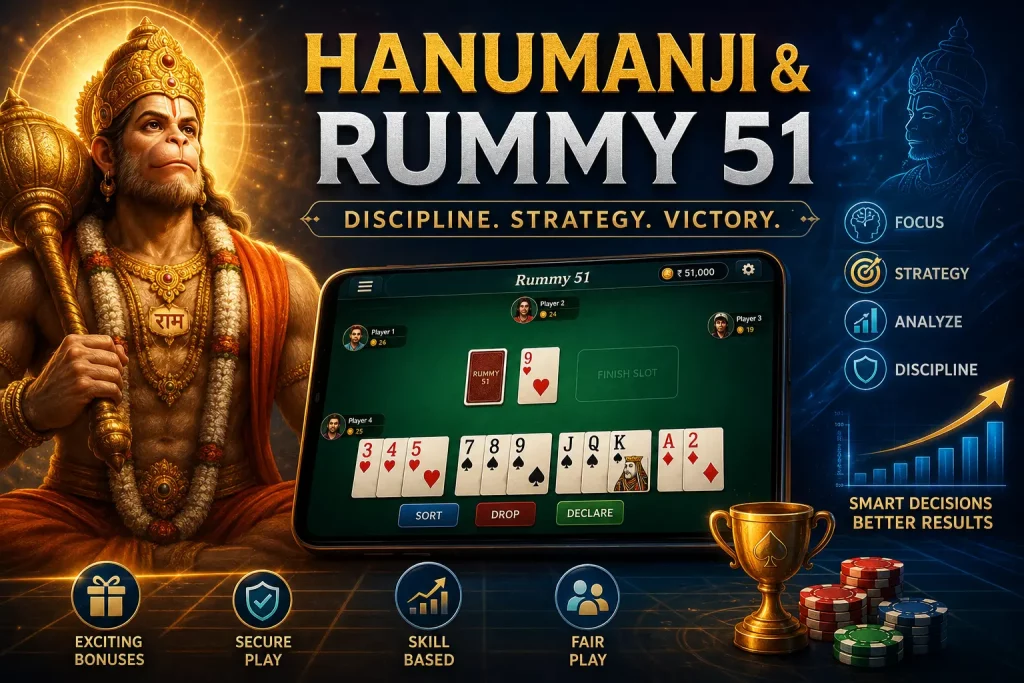
Hanumanji Symbolism and Strategic Thinking
Hanumanji represents more than devotion; he represents controlled energy. In gameplay terms, this translates into:
- Staying calm under pressure
- Making logical decisions instead of emotional ones
- Maintaining focus over long sessions
- Avoiding impulsive moves
- Practicing discipline in resource usage
These traits are directly relevant when engaging with modern online platforms such as Rummy 51, where decisions must be made quickly but carefully.
To better understand this connection, here is a structured breakdown:
Hanumanji Traits & Player Skill Mapping
| Hanumanji Quality | Meaning in Gaming | Practical Impact |
|---|---|---|
| Devotion | Focus on long-term strategy | Better consistency in wins |
| Strength | Mental resilience | Reduced tilt during losses |
| Wisdom | Decision analysis | Improved move selection |
| Courage | Risk-taking ability | Higher reward opportunities |
The Digital Evolution of Traditional Mindset
While Hanumanji represents ancient spiritual wisdom, modern platforms like Rummy 51 reflect how traditional mental discipline is applied in a digital environment. The transition from physical card games to online ecosystems has introduced new layers of engagement such as fast matchmaking, live competition, and structured reward systems.
However, the core principle remains unchanged: success depends on the player’s mental clarity rather than randomness alone.
The digital gaming world rewards those who can maintain steady focus and adapt quickly. Just like Hanumanji’s unwavering determination, a strong player must remain committed even when conditions are unpredictable.
Core Principles for Players Inspired by Hanumanji
Before moving deeper into strategies, it is important to understand the foundational principles that guide performance improvement:
- Consistency over impulsiveness
- Observation before action
- Strategic patience
- Emotional stability
- Continuous learning
These principles act as a bridge between spiritual discipline and modern gaming intelligence.
Why Mindset Matters in Rummy 51
Rummy 51 is not just about random card distribution; it is about pattern recognition, probability understanding, and calculated decision-making. Players who approach the game emotionally often lose control, while those who maintain focus tend to perform better over time.
Hanumanji’s symbolic energy represents exactly this controlled focus. It is not about aggression but about clarity and timing.
Foundation of Strategic Awareness
A strong player develops awareness in three key areas:
- Self-awareness: understanding personal strengths and weaknesses
- Game awareness: tracking patterns and probabilities
- Opponent awareness: reading behavior and predicting moves
These layers of awareness form the foundation of advanced gameplay strategy.
How Digital Reward Systems Shape Player Behavior
Modern gaming platforms are designed to keep players engaged through structured incentives. These systems influence how users interact with features like progression, bonuses, and gameplay repetition.
In environments such as Rummy 51, players often respond differently depending on reward visibility, timing, and perceived value. This creates measurable behavior patterns that can be analyzed.
Below is an interactive breakdown of how different engagement elements affect player actions.
Engagement Triggers in Digital Gameplay
| Trigger Type | Player Reaction | Outcome Effect |
|---|---|---|
| Login Bonus | Daily return motivation | Higher retention rate |
| Sign up rewards | Early engagement boost | Faster onboarding |
| Game progression | Competitive continuation | Long-term activity increase |
| Reward milestones | Achievement-driven play | Higher session duration |
Understanding Controlled Decision Cycles
Every round in a card-based system can be seen as a cycle:
- Observe available information
- Evaluate potential outcomes
- Choose the most stable move
- Accept result and reset mindset
This cycle is extremely important because emotional interference breaks it. Players who react too quickly often skip evaluation and lose long-term consistency.
Hanumanji’s symbolism of discipline reflects the importance of staying within this cycle without emotional disruption. The idea is not to eliminate risk, but to control reaction to risk.
Behavioral Stability in Competitive Play
When players experience consecutive wins or losses, their decision quality often changes. This is a natural psychological response. However, the most stable players maintain equilibrium regardless of outcome.
Stability can be measured across three behavioral dimensions:
- Reaction speed consistency
- Risk evaluation accuracy
- Emotional neutrality after outcomes
These factors often determine long-term success more than isolated wins.
Player Engagement Flow (Rummy 51 Behavior Model)
TThe Role of Structured Incentives
Structured incentive systems in digital platforms are not random—they are carefully designed frameworks that subtly guide user behavior over time. Rather than simply rewarding actions, they shape how users plan, decide, and return to the system. In card-based or competitive environments, these incentives often become an invisible layer that influences pacing, engagement depth, and strategic consistency.
Most platforms rely on several core types of structured incentives, each serving a slightly different psychological function:
- Time-based rewards encourage repeated return cycles by offering benefits tied to specific intervals. This creates a rhythm of engagement where players naturally organize their activity around predictable reward windows.
- Progress tracking systems provide a visible sense of advancement, transforming individual actions into part of a larger journey. Even small improvements feel meaningful when they contribute to an overall progression path.
- Milestone achievements act as psychological checkpoints. They reinforce commitment by marking clear stages of success, making long-term engagement feel structured rather than random.
- Event-based bonuses introduce variability and urgency, temporarily shifting player focus and increasing attention during specific periods or conditions.
Together, these mechanisms form a continuous behavioral loop. The player engages, receives feedback, perceives progress, and is naturally encouraged to continue. Importantly, this loop does not operate purely on logic—it blends anticipation, reward expectation, and habit formation into a single system that sustains interaction over time.
When these structured incentives are combined with disciplined decision-making, their effect changes significantly. Instead of driving impulsive engagement, they can reinforce strategic awareness. The player begins to interpret rewards not as emotional triggers but as informational signals—data points that help understand timing, pacing, and system structure.
In this way, engagement becomes more intentional. Rather than reacting to incentives, the player learns to operate within them, using the system’s structure to support calculated decisions instead of emotional responses. This shift is what transforms structured incentives from simple motivational tools into components of deeper strategic play.
Connection Between Discipline and Digital Rewards
In digital card-based environments, rewards are often designed to feel immediate and emotionally engaging. Points, wins, streaks, or bonuses can create a strong psychological response that pulls attention toward short-term outcomes. However, the key insight is that rewards themselves do not determine long-term success. What truly shapes outcomes is how the player interprets and reacts to those rewards within their decision-making process.
A disciplined mindset acts as a stabilizing layer between emotional reaction and strategic action. Instead of letting results dictate behavior, disciplined players maintain a consistent internal structure that guides how they respond in both winning and losing situations.
This structure becomes especially important in environments where outcomes are uncertain and rapidly changing. Without discipline, even small fluctuations in results can lead to exaggerated responses—either overconfidence after a win or rushed attempts to “recover” after a loss.
A strong disciplined approach ensures that:
- Rewards do not trigger overconfidence or unnecessary risk-taking, keeping decisions grounded in logic rather than excitement.
- Losses do not create impulsive recovery attempts, which often lead to escalating mistakes and emotional play.
- Gameplay remains structured and consistent, with each decision following a stable internal strategy rather than momentary emotional shifts.
Over time, this consistency creates a more reliable performance pattern. Instead of being pulled by the emotional highs and lows of the game, the player operates within a controlled framework where decisions are based on logic, observation, and long-term thinking.
This is where the symbolic idea of Hanumanji becomes relevant again—not as mythology in a literal sense, but as a mental model for self-control and clarity. In this context, Hanumanji represents the ability to stay centered under pressure, maintain focus despite distractions, and act with intention rather than impulse.
Using this framework as inspiration, discipline becomes less about restriction and more about alignment—keeping actions consistent with long-term strategy rather than short-term emotional reactions. This balance is what ultimately separates reactive play from structured, sustainable decision-making in digital reward systems.
Decision Layers in Strategic Gameplay
A structured approach to gameplay typically involves three layers of thinking:
First is the immediate layer, where a player reacts to visible cards or available options. Second is the analytical layer, where probabilities and potential outcomes are evaluated. Third is the strategic layer, where long-term patterns and opponent tendencies are considered.
Players who operate only at the first layer tend to rely on instinct. Those who reach the second and third layers tend to perform more consistently over extended sessions.
Decision Layers in Rummy 51 Gameplay
| Layer | Focus Area | Player Behavior |
|---|---|---|
| Immediate | Visible cards & instant options | Fast reaction, instinct-based moves |
| Analytical | Probability & hand evaluation | Calculated risk-taking |
| Strategic | Opponent patterns & long-term planning | Controlled, disciplined play |
The Role of Probability Awareness
In card-based systems, probability awareness is less about trying to forecast exact outcomes and more about gradually reducing uncertainty. Instead of treating each move as a fixed prediction, experienced players understand that every decision exists within a range of possible futures. This mindset shifts focus from “what will happen” to “what is most likely to happen given the current information.”
As the game progresses, skilled players constantly refine their internal model of the situation. They take into account visible cards, past actions, opponent behavior patterns, and remaining unknown variables. This doesn’t produce certainty, but it narrows down the field of possibilities enough to make better-informed decisions than purely instinctive play.
This adaptive thinking naturally forms a continuous feedback loop:
Observe the game state — players carefully track what has already been played, what is still possible, and how the situation is evolving.
Estimate possible outcomes — based on incomplete information, they mentally map several likely scenarios rather than relying on a single expectation.
Adjust strategy dynamically — decisions are updated in real time, shifting between cautious and aggressive approaches depending on how probabilities change.
Learn from results — each round becomes additional data, improving future judgment and sharpening pattern recognition.
Over time, this loop strengthens decision accuracy in a subtle but powerful way. Instead of reacting emotionally or impulsively, players begin to act with a structured awareness of risk and likelihood. This doesn’t eliminate uncertainty, but it significantly reduces its impact, leading to more stable, consistent decision-making even in complex or changing game situations.
Behavioral Balance and Emotional Control
Even with strong analytical thinking, emotional control remains a decisive factor. Loss streaks or unexpected outcomes can distort judgment if the player is not mentally stable.
This is where the symbolic interpretation of Hanumanji becomes important again. It represents the ability to remain steady regardless of external fluctuations. In gameplay terms, this means not changing strategy due to short-term outcomes.
Player Focus Distribution (Advanced Decision Model)
Adaptive Thinking in Long Sessions
Long gameplay sessions require adaptation. Early decisions influence later options, meaning each move has both immediate and delayed consequences.
Players who adapt successfully tend to:
- Re-evaluate assumptions frequently
- Avoid rigid strategies
- Balance aggression and caution
- Maintain mental consistency
These habits significantly improve long-term performance stability.
Core Master Framework in Gameplay
Instead of reacting individually to each round, advanced players build a continuous loop of improvement:
- They observe outcomes without emotional attachment
- They adjust strategy based on long-term patterns
- They avoid overreacting to short-term wins or losses
- They maintain consistent decision logic across sessions
This creates a stable performance curve rather than volatile results.
Master Strategy Framework (Rummy 51)
| Strategic Layer | Key Focus | Resulting Advantage |
|---|---|---|
| Mental Discipline | Emotional stability during outcomes | Consistent decision quality |
| Probability Thinking | Evaluating possible outcomes | Reduced random mistakes |
| Pattern Recognition | Tracking repeated game behaviors | Better predictive decisions |
| Adaptive Strategy | Adjusting to game flow | Higher long-term stability |
The connection between the symbolism of Hanumanji and modern gameplay strategy is rooted in one fundamental principle: control under uncertainty. In both philosophical tradition and digital environments such as card-based systems like Rummy 51, success is not defined by eliminating unpredictability, but by maintaining clarity and composure while navigating it.
Uncertainty is a constant factor in gameplay. Players rarely have full information, and outcomes are shaped by shifting probabilities, opponent decisions, and evolving game states. In such conditions, emotional reactions often become the main source of error. Impulsiveness, frustration after losses, or overconfidence after wins can distort judgment and lead to inconsistent results. The symbolic idea of Hanumanji represents the opposite of this instability—steady awareness, focused intention, and disciplined action even when conditions are unclear.
When players begin to internalize structured thinking habits, their decision-making process gradually transforms. Instead of reacting moment by moment, they start to interpret each situation within a broader strategic context. Moves are no longer isolated responses but part of a continuous reasoning process that considers probability, timing, and risk balance.
This shift leads to several long-term improvements. Decisions become less reactive, meaning players are no longer driven primarily by immediate emotional pressure. Choices become more calculated, based on observation and pattern recognition rather than impulse. As this mindset develops further, consistency naturally improves, because actions begin to follow a stable internal logic instead of fluctuating emotional states.
Over time, this structured approach also deepens understanding of game flow. Players start to recognize recurring patterns, pacing shifts, and strategic turning points within the game. Instead of viewing each round as independent, they perceive continuity between decisions, which allows for better anticipation and adaptation.
Ultimately, the combination of disciplined thinking and symbolic clarity—represented by Hanumanji—supports more stable performance outcomes. It does not remove uncertainty from the game, but it changes how uncertainty is handled. And in strategic environments, the ability to remain steady within unpredictability becomes one of the most important factors for long-term improvement.
FAQ – Rummy 51 Strategy
What is the main skill needed in Rummy 51?
The main skill is decision consistency based on probability and pattern awareness rather than emotional reaction.
Does luck affect long-term results?
Short-term outcomes depend on randomness, but long-term performance is strongly influenced by strategy and discipline.
Why is emotional control important?
Emotional control prevents impulsive decisions and helps maintain structured gameplay even during losses.
How do rewards affect gameplay behavior?
Rewards increase engagement but can also lead to overconfidence if not balanced with disciplined thinking.
What is the best strategy approach?
A balanced approach combining probability, observation, and emotional control creates the most stable performance.