Poker is widely recognized as one of the most psychologically deep and strategically demanding card games ever created. In the context of the Rummy 51 ecosystem, it plays an important role not just as a standalone game but as a training ground for probability thinking, emotional discipline, and structured decision-making under uncertainty.
Unlike many casual card games where outcomes depend heavily on immediate luck, poker operates on a layered system of incomplete information. Every decision is made without full knowledge of opponent cards, meaning that success depends on interpretation, timing, and the ability to evaluate risk continuously rather than reactively.
At its core, poker is built around a simple idea that becomes increasingly complex in practice. Each player is given a set of hidden cards, and over a sequence of betting rounds, additional shared cards may appear depending on the variant being played. The objective is not simply to hold strong cards, but to extract maximum value from situations where your perceived strength, betting behavior, and timing work together to influence opponents’ decisions.
In digital environments such as Rummy 51, poker is often integrated into broader gaming ecosystems where users move fluidly between different formats like Slots Games. This transition between game types reflects how modern players engage with risk-based entertainment, shifting between structured strategy and chance-driven experiences depending on preference and mood.
To access these systems, users typically interact through platforms that include Login Bonus features, Sign up flows, and sometimes APK-based installations for mobile convenience. Some ecosystems also provide direct Links that guide users into different game lobbies, ensuring smooth navigation across multiple formats within a single environment.
Understanding poker begins with recognizing that it is not a game of isolated hands. Instead, it is a continuous process of adaptation. Each decision influences future perception, and each betting action communicates information to other players, whether intentionally or not. This makes poker fundamentally different from games where outcomes are determined at a single moment.
A central aspect of poker is the hierarchy of hand strength, which determines the relative power of different card combinations. While beginners often focus too heavily on memorizing these rankings, the deeper importance lies in understanding how rarely the strongest hands appear and how frequently medium-strength hands must be played under uncertainty. The strongest possible hand, such as a royal combination, is extremely rare, while more common outcomes like one pair or high card situations dominate actual gameplay. This imbalance shapes all strategic decisions.
Equally important is the structure of gameplay flow. A typical poker round progresses through phases of investment and information revelation. Players contribute forced bets at the beginning, receive private cards, and then enter cycles of decision-making where they can either continue investing, increase pressure on others, or exit the round entirely. As shared cards appear in many poker variants, the amount of visible information gradually increases, but uncertainty always remains at the center of the experience.
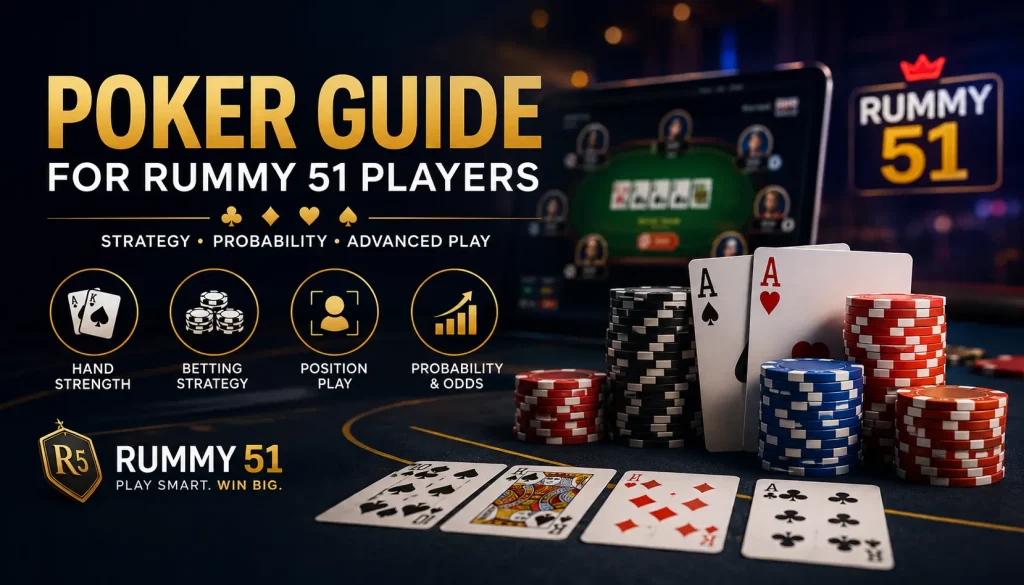
What makes poker particularly relevant for players in systems like Rummy 51 is the way it trains long-term thinking. Instead of focusing on a single winning moment, experienced players evaluate entire sequences of outcomes. They consider how early decisions affect later possibilities, how opponents adjust their behavior over time, and how psychological pressure influences betting patterns.
The digital format of poker has further expanded its accessibility and complexity. Online environments allow for faster gameplay cycles, automated shuffling, and structured user progression systems. These environments often blend multiple engagement mechanics, such as reward systems tied to Login Bonus structures or onboarding flows connected to Sign up incentives. Mobile-first ecosystems also introduce APK-based installation options, allowing users to access poker platforms directly from their devices without traditional browser limitations.
Within these ecosystems, poker is frequently presented alongside other entertainment categories, including Slots Games, creating a multi-layered gaming environment where users can switch between skill-based and chance-based experiences. This diversity encourages players to explore different forms of risk engagement, while still maintaining a central connection to probability-driven thinking.
However, beginners often struggle because they approach poker as a game of immediate hand strength rather than a system of evolving information. One of the most common mistakes is overvaluing individual hands without considering how those hands interact with betting behavior, position, and opponent tendencies. Another frequent issue is failing to recognize that the same hand can have completely different value depending on context.
Position is one of the most critical hidden advantages in poker. Acting later in a round allows a player to observe the behavior of others before making a decision. This additional information often leads to more accurate judgments and better long-term outcomes. Conversely, early positions require decisions with less information, increasing uncertainty and forcing a more conservative or strategically disciplined approach.
Beyond mechanics, poker is deeply influenced by psychological interpretation. Every bet carries meaning beyond its numerical value. A small bet might signal caution or trap-setting behavior, while a large bet might represent aggression, bluffing, or strong hand protection. Learning to interpret these signals is one of the most advanced skills in the game.
To better understand how hand strength translates into real-world probability, the following interactive structure provides a simplified overview of common poker outcomes. It is designed with a dark visual theme suitable for modern gaming environments.
Poker Hand Structure
| Hand Type | Relative Strength | Approximate Occurrence |
|---|---|---|
| Royal Flush | Maximum | Extremely Rare |
| Full House | Very Strong | Rare but playable |
| Flush | Strong | Occasional |
| Straight | Moderate | Moderate frequency |
| One Pair | Weak to Medium | Very common |
By understanding this foundational structure, players begin to see poker not as isolated rounds of chance but as a continuous system of decision-making under uncertainty. The real skill emerges when these concepts become intuitive rather than memorized.
Betting as the Core Language of Poker
Poker is essentially a communication system where chips replace words. Every action a player takes—checking, calling, raising, or folding—forms part of a structured language that reveals intention, uncertainty, or aggression.
A small bet can signal control or cautious value extraction. A large bet can represent either strong confidence or a deliberate bluff designed to force opponents into mistakes. The complexity arises from the fact that none of these signals are absolute; they only gain meaning when interpreted within context.
Over time, players learn that betting is not about winning individual hands but about constructing long-term pressure patterns that influence how opponents behave in future rounds.
Blind Structure and Pot Formation
Before any cards are dealt in most poker formats, forced bets called blinds are placed into the pot. These blinds ensure that there is always something to compete for, which creates natural tension in every hand.
As betting rounds progress, the pot grows incrementally, and each decision becomes more significant because the value at stake increases. This scaling structure is what makes poker mathematically dynamic: early decisions may involve small risks, while later decisions can involve substantial commitment relative to stack size.
Understanding how pot size evolves is essential because experienced players constantly evaluate whether a decision is justified based on potential return versus risk exposure.
Position determines the order in which players act during a hand, and it is one of the most important hidden advantages in poker.
When a player acts early, they must make decisions without knowing what others will do. This increases uncertainty and forces more conservative play. In contrast, players acting later have the advantage of observing multiple actions before making their own decision. This additional information often leads to more accurate reads and better long-term profitability.
In practical terms, position transforms identical hands into completely different strategic situations depending on where a player sits at the table.
Every poker hand follows a psychological rhythm. Early stages are characterized by uncertainty and cautious exploration. Middle stages often involve increased aggression as players attempt to define the strength of their opponents. Final stages become highly polarized, where decisions usually involve either strong commitment or complete withdrawal.
This flow is what makes poker unique among competitive games. It is not static; it evolves dynamically based on player behavior, bet sizing, and perceived risk.
Strategic Behavior in Digital Environments
In modern platforms, poker is often integrated into broader gaming ecosystems where users may also interact with Slots Games or other formats. This ecosystem approach encourages players to switch between skill-based and chance-based experiences depending on their mood and risk preference.
Onboarding systems such as Login Bonus rewards and Sign up incentives are commonly used to introduce new players into these environments. Mobile accessibility is often supported through apk installation options, allowing seamless access across devices. Some platforms also provide direct Links that simplify entry into different game sections, improving navigation and engagement flow.
These digital structures influence how players perceive pacing, rewards, and risk distribution over time.
Poker Betting Dynamics
Betting Strategy
| Position | Information Level | Recommended Behavior |
|---|---|---|
| Early Position | Low | Conservative, selective play |
| Middle Position | Medium | Balanced aggression and observation |
| Late Position | High | Aggressive exploitation of information advantage |
One of the most important skills in poker is learning how to interpret betting sequences rather than isolated actions. A single raise means very little without context, but a sequence of consistent aggression across multiple rounds can indicate strong structural confidence or a deliberate bluff strategy.
Experienced players focus less on what they hold and more on what their opponents are representing through their actions. This shift in perspective is what separates intermediate players from advanced ones.
Poker probability is not about memorizing exact percentages. Instead, it is about understanding frequency bands—how often certain outcomes appear over time and how those frequencies shape correct decision-making.
For example, premium hands appear rarely, while medium-strength hands dominate most sessions. This imbalance forces players to spend most of their time making decisions under uncertainty rather than certainty. As a result, long-term success depends on how efficiently a player handles average situations rather than rare ones.
This is why experienced players often appear “less emotional” during gameplay. They are not reacting to individual outcomes, but to statistical expectations across many hands.
Player Archetypes and Behavioral Patterns
In competitive poker environments, players tend to fall into recognizable behavioral categories. These are not fixed identities but dynamic tendencies that shift based on pressure, stack size, and confidence.
Some players consistently behave in a cautious, defensive way, avoiding unnecessary risk and focusing on survival. Others adopt aggressive pressure-based strategies, forcing opponents into uncomfortable decisions. There are also adaptive players who shift style depending on table conditions, exploiting weaknesses as they appear.
Understanding these archetypes allows players to predict likely actions even before cards are revealed, which significantly improves decision accuracy.
One of the most important hidden concepts in poker is risk distribution. Not every decision carries equal importance, and not every hand should be treated as equally valuable. Strong players learn to allocate risk selectively, accepting small losses in low-value situations to preserve capital for high-value opportunities.
This creates a long-term efficiency curve where gains are maximized during favorable conditions and losses are minimized during unfavorable ones. Over time, this asymmetry becomes the foundation of consistent performance.
Interactive Probability
| Hand Type | Frequency (Approx.) | Strategic Meaning |
|---|---|---|
| Royal / Straight Flush | <0.02% | Rare win condition, not base strategy |
| Full House | ~2.6% | High-value extraction hands |
| Flush / Straight | ~7–8% | Medium aggression threshold |
| Pair / Two Pair | ~40–45% | Core decision-making range |
| High Card | ~45% | Bluffing and fold equity zone |
As the game progresses, players naturally experience increasing psychological pressure due to rising pot sizes and narrowing decision windows. Early stages tend to involve exploration and information gathering, while later stages force commitment decisions where uncertainty becomes more costly.
This pressure curve is what creates emotional imbalance in inexperienced players. Advanced players stabilize this curve by treating every decision as part of a larger expected-value system rather than an isolated emotional event.
Probability Evolution
Once probability understanding and behavioral recognition become natural, poker stops feeling like a reactive game and starts functioning as a structured decision model. At this stage, players begin to anticipate outcomes rather than respond to them, which significantly improves long-term efficiency.
The next stage of mastery focuses on exploitation strategies, adaptive bluffing systems, and digital ecosystem optimization, where platform behavior itself becomes part of strategic thinking.
Exploitation Strategy and Adaptive Play
Advanced players do not follow fixed strategies. Instead, they constantly adjust based on how opponents behave over time. If a player notices that opponents fold too often under pressure, they increase bluff frequency. If opponents call too frequently, they shift toward value-heavy play and reduce unnecessary risk.
This adaptability creates a feedback loop where every action becomes both a decision and a data point. Over time, this leads to increasingly precise reads and more efficient capital use.
One of the most important advanced concepts is controlled aggression. Aggression in poker is not about constant pressure, but about applying pressure at the correct moments when fold probability and value potential align.
This means aggressive actions are not random—they are calculated responses to structural weakness in opponent behavior or statistical advantage in specific board conditions.
Timing becomes more important than volume. A single well-timed aggressive sequence can outperform multiple weak attempts.
Digital Ecosystem Awareness
Modern poker environments are often part of larger gaming systems that include Slots Games, promotional mechanics, and onboarding structures such as Login Bonus and Sign up rewards. These systems influence player behavior indirectly by shaping session length, engagement cycles, and risk tolerance.
Some platforms also use APK-based mobile access or direct Links for game entry, which can affect how quickly players enter sessions and how frequently they rotate between game types.
Advanced players recognize that these external factors subtly influence table dynamics, especially in mixed-skill environments.
At the highest level, poker success is defined less by individual wins and more by consistency over time. Bankroll stability becomes the foundation of sustainable play. Even strong strategies fail if risk is not properly controlled across sessions.
Advanced players focus on preserving decision-making capacity across long time horizons rather than maximizing short-term spikes. This mindset reduces emotional variance and improves long-term expected value.
Risk Efficiency
| Strategy Type | Risk Level | Expected Outcome |
|---|---|---|
| Passive Play | Low | Stable but limited growth |
| Balanced Strategy | Medium | Consistent long-term profitability |
| Aggressive Exploitation | High | High variance, high reward |
Poker is ultimately not defined by individual wins or losses, but by the quality of decisions made over time. Every hand is just a small part of a much larger system where probability, timing, and human behavior continuously interact.
As you progress through the concepts in this guide, the main shift is mental rather than mechanical. At the beginning, poker feels like a game of cards. Later, it becomes a game of information. Eventually, it turns into a game of structured decisions under uncertainty, where every action is evaluated not by its immediate result, but by its long-term impact.
In digital ecosystems like Rummy 51, this perspective becomes even more important. The pace of play is faster, the number of decisions is higher, and the influence of platform dynamics makes emotional control and consistency essential. Players who treat poker as a reactive game tend to fluctuate heavily, while those who approach it as a structured system develop stability and long-term improvement.
The strongest takeaway is simple: success in poker is built through patience, discipline, and the ability to think beyond single outcomes. When decisions are guided by logic rather than impulse, performance naturally becomes more consistent, regardless of short-term variance.
In the end, poker rewards those who stay calm under uncertainty, adapt intelligently, and always think in terms of patterns rather than isolated moments.
FAQ – Poker Guide
What is the main skill in poker?
Decision-making under uncertainty based on probability and opponent behavior.
Is poker only luck?
No. Long-term results depend more on strategy than individual hands.
Why is position important?
It gives more information before making decisions, improving accuracy.
How does digital poker differ?
It includes faster pacing, platform rewards, and ecosystem-driven behavior patterns.